OEM means we manufacture to your drawing, usually in 30–45 days including logistics. ODM means we start from an in-house mold, then your artwork, usually in 45–60 days including logistics. Wholesale is a reorder of a structure you have already approved.
When the drawing should lead
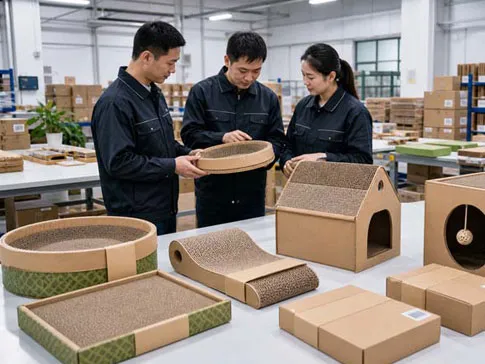
Choose OEM when the silhouette, the opening, or the packed size is already decided. You send PDF, AI, or EPS after the structure is set. Die-cutting, printing, and packing stay on one floor in Shenzhen. Bulk built to your specification is usually 30–45 days, including logistics.
OEM is the path for a hero SKU that must match a retail dieline, a private-label opening, or a packed size you already sell. The factory does not invent a second structure beside the file you approved. A structure sample comes first, so size and fit are checked before the official sample.
When a mold is enough
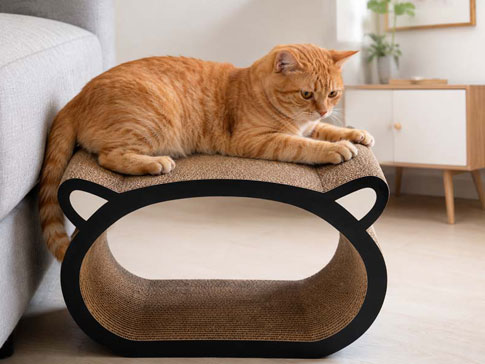
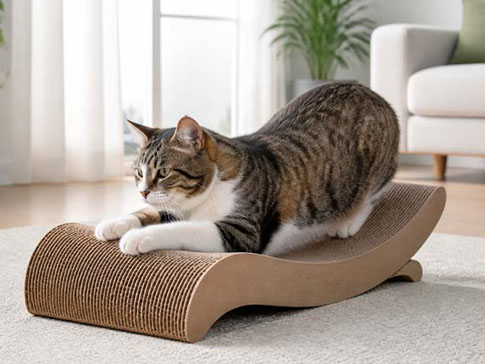
Choose ODM when you know the category and the price band, and you want a shape cats already use. Petaful has 200+ molds. A house, a lounge, a post, or a modular set can be adjusted before the official sample. Bulk from those molds is usually 45–60 days, including logistics.
ODM is the private-label path. You describe the market and send artwork. Buyer artwork stays with the program. An NDA can be signed before files move. You do not need a finished drawing set to start, but you do need a clear use: scratch, stretch, hide, lounge, or play.
What both paths share
- Agree the structure.
- Sample it. The official sample is usually ready in 5–7 days, and it is free for new partners.
- Lock the artwork.
- Cut bulk, with IQC, IPQC, and FQC before the cartons close.
A complex job adds 10–15 days. Trade terms from Shenzhen can be EXW, FOB, or DDP. Board is recyclable corrugated, bonded with corn starch glue. Flute is chosen in the sample: BC for a lounge or a house, B for a pad, E when the face is mostly print. The side-by-side is on OEM and ODM. Material notes are on board and flute.
Wholesale sits beside both paths. It repeats an approved structure for a brand or Amazon program. It is not a separate factory. Carton marks, barcodes, and retail inserts are prepared in Shenzhen before the cartons close.
What to put in the brief
Name the market, the behavior the cat should use, the packed size if you already know it, and whether the job is a drawing, a mold, or a reorder. Send a reference photo when you do not have a dieline. Do not send a single minimum and expect it to fit every build. Quantity follows the structure, the print, and the pack, and sales confirms the run before production.
The plant is 5,000 m² with a team of 100+, shipping to 30+ export markets since 2020. Those figures are the same ones on About and on the factory page. Annual capacity and equipment counts are not published, so this note does not invent them. If the file is print-ready, say so. If the mold only needs artwork, say that too. Mixing a custom hero with mold-based companions is normal. Write it in the first email so sampling stays on one schedule.
Questions
Do I need a full dieline to start?
For OEM, yes, or a drawing we can turn into one. For ODM, a reference photo and a target size are enough to match a mold.
Can one program mix both?
Yes. A hero SKU can be OEM while the rest of the line starts from molds. Say so in the brief.

Factory editor
Edits sourcing notes for pet brands and Amazon sellers, from the Petaful floor in Shenzhen.