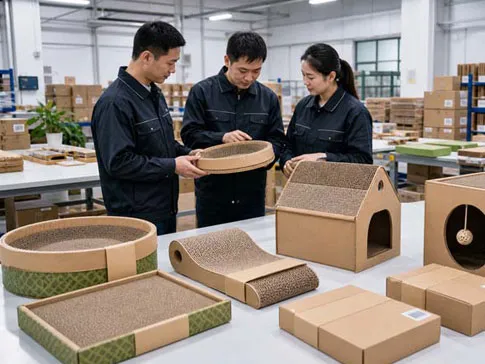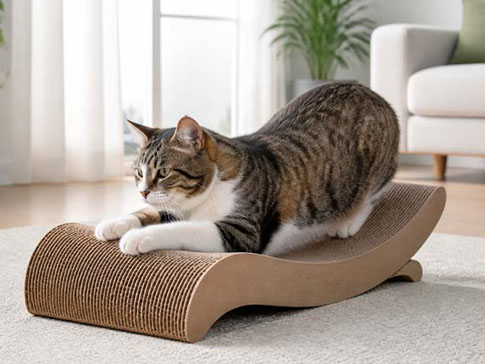
There is no single month count for how long a cardboard cat scratcher lasts. Life depends on the flute, the humidity, how many cats use the piece, and whether the face can be flipped or the core replaced.
What changes the life
- Density and flute. A BC lounge is a different wear item from a thin graphic pad.
- How many cats use it, and whether they scratch across the flute or along it.
- Humidity. Soft, damp board sheds sooner.
- Whether the worn face can be flipped or the core replaced.
Petaful sets density and flute in the sample. We do not print one lifespan on every SKU. Reversible pads and replaceable cores are the practical way to extend a retail program. See the flute table on materials. BC flute suits a lounge or a house. B flute suits a pad. E flute suits a face that is mostly print. The glue is corn starch.
A holiday graphic does not change that rule. The print is a face. The scratch life is still the board under it. Sample both if the graphic covers the main scratch zone. Official samples are usually ready in 5–7 days after the artwork is agreed, which is enough time to feel the flute before a seasonal window.
When to tell a customer to replace it
Replace the piece when it sheds a lot, smells damp, sags under the cat, or comes apart at a glued joint. A frame with a refill panel is the SKU to offer next to that moment. Do not promise a month count on the carton unless that SKU was sampled for it. This factory does not publish one lifespan for the whole catalog.
How a buyer should write the claim
On a retail line, describe the conditions instead of a month. Say the board stays useful while it is dry, holds its shape, and still feels worth scratching. Offer a refill core or a reversible face when the structure has one. A framed pad that lies flat, leans, or hangs is the refill story. A seasonal tree or a phone-shaped wall pad is a print face on corrugated board, not a different lifespan rule.
If a customer asks for a laboratory month count, do not borrow one from another factory. Sample the density you intend to sell. IQC checks incoming board. IPQC checks glue and moisture while the job runs. FQC checks the finished piece before the carton closes. Those checks keep a run consistent. They are not a promise that every cat will wear a pad at the same speed.
Questions
Does a thicker board always last longer?
Thicker is not automatically better. The flute has to match the job. A print face in E flute often needs a denser core underneath if claws are heavy.
Can holiday print shorten the life?
The print is a face. The scratch life is still the board under it. Sample both if the graphic covers the main scratch zone.

Factory editor
Edits sourcing notes for pet brands and Amazon sellers, from the Petaful floor in Shenzhen.